Limit
Concept Explanation
Limit is the value which shows what is f(x) moving toward for a specific value of x.it describes the functions behaviour near a point rather than its value at a point.
Subtopics
Definition of a Limit
A limit is the value that a function f(x) approaches as the input x gets closer and closer to a specific point c.
Notation
Limit is denoted as limx–>cf(x)=L,lim is the short form of which will stay same at every place.x->c represents the value of x is getting closer to c.f(x) is the function used. [to read more about function click here].L is the value towards which f(x) moves.
Limits from a graph
We are using f(x)=x²-1/x-1. we see the broken graph at x=1 as f(x) for 1 is undefined as the numerator becomes 0.
=x.x-1x-1.png)
graph of f(x)=x²-1/x-1 for limit with hole
Graph lying towards left is approaching from left and is denoted by limx–>c-f(x)=L in this case it is limx–>1-f(x)=2
Graph lying towards right is approaching from right is denoted by limx–>c+f(x)=L in this case it is limx–>1+f(x)=2
To calculate limit graphically we look where is the graph heading for a value of x.we don't directly take x but we get closer and closer to x.
limit from a table
to calculate limit from a table we take values from both left and right. the example is of limx–>1f(x)=\frac{x²-1}{x-1}.
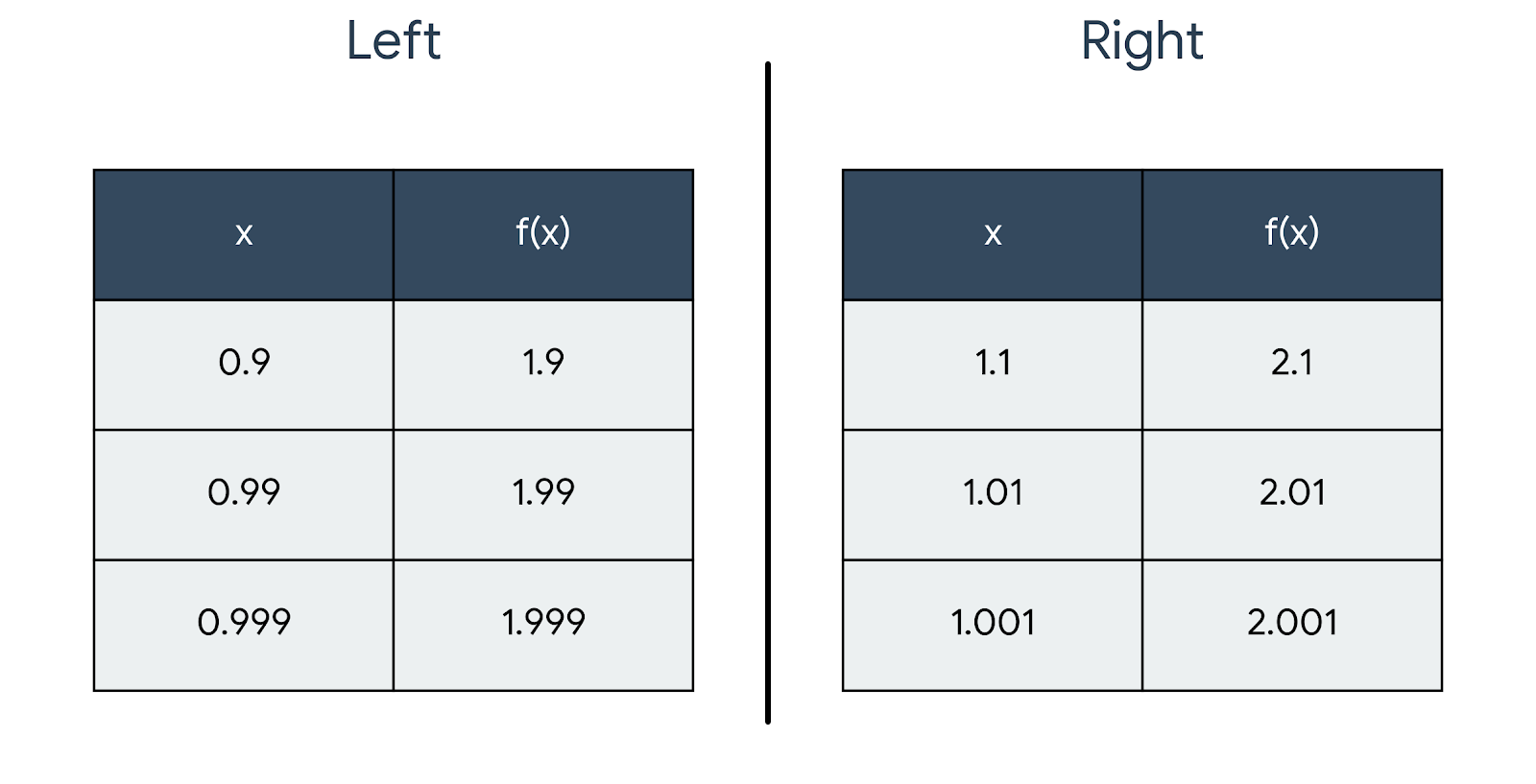
table of value
we can see as the value of x gets closer to 1 the value of f(x) gets closer to 2.
Note:- if you will take x directly as 1 then it will come as undefined not 2
When does limit exists?
A limit only exists when limx–>a-f(x)=limx–>a+f(x) as in the example above left limit is 2 and right limit is 2 so the limit exist.
Laws on Limits
1.Sum law- limx–>a[f(x)+g(x)]=limx–>af(x)+limx–>ag(x), this law tells that limit of sum of f(x) and g(x) as x approaches a will be equal to sum of limits of f(x) and g(x) as x will approach a
2.Difference law- limx–>a[f(x)-g(x)]=limx–>af(x)-limx–>ag(x), this law tells that limit of difference of f(x) and g(x) as x approaches a will be equal to difference of limits of f(x) and g(x) as x will approach a
3.Product law- limx–>a[f(x)•g(x)]=limx–>af(x)•limx–>ag(x), this laws tells that limit of product of f(x) and g(x) as x approaches a will be equal to product of limits of f(x) and g(x) as x will approach a
4.Quotient law- limx–>a[f(x)/g(x)]=limx–>af(x)/limx–>ag(x), this law tells that limit of quotient of f(x) and g(x) as x approaches a will be equal to quotient of limits of f(x) and g(x) as x will approach a
History Corner
Limits were used in 3rd century BCE by Archimedes and Eudoxus of Cnidus which they called "Method of Exhaustion" but the limits which we use today were given by Isaac Newton and Gottfried Wilhelm Leibniz in around 1687.
Extras Corner
- is it possible that a can limit give 2 values?
- give an example of a function which can't give limit for a value of x.